Back to home
ABOUT ME

About me.
Technology and hobbies.

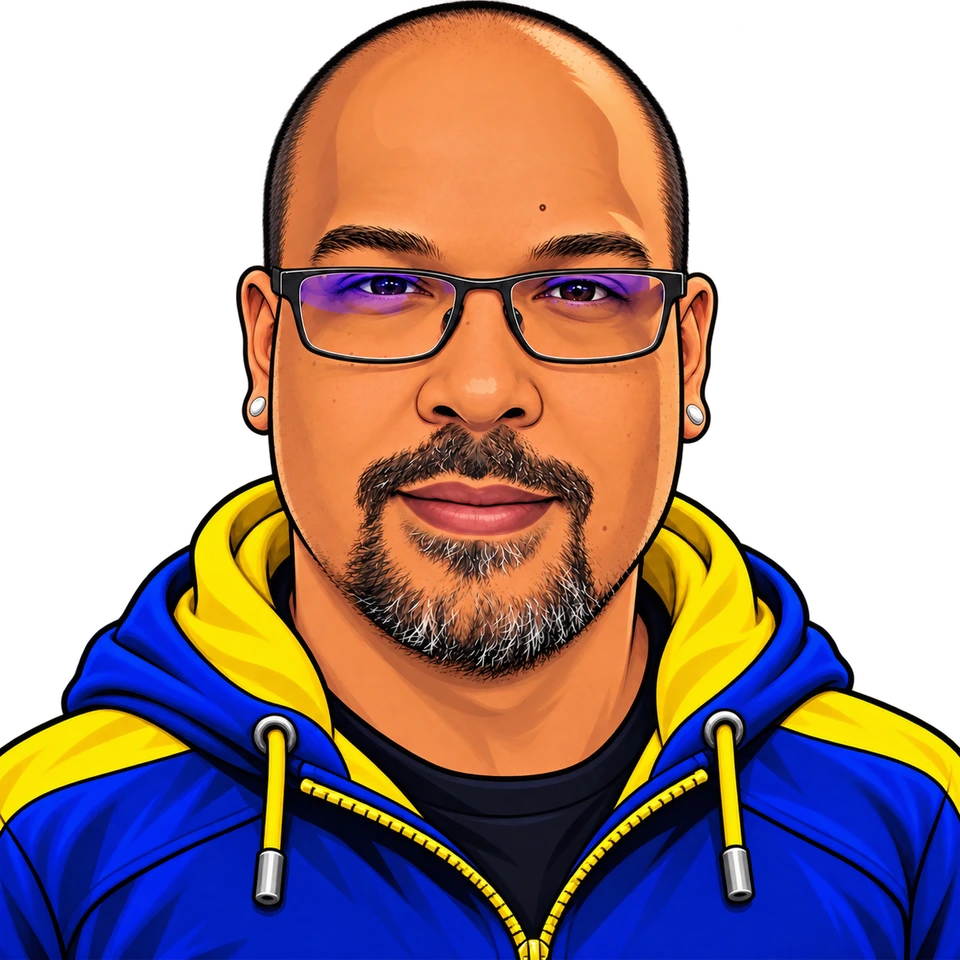
I'm Dennis Blau, known online as duCki. I'm an IT administrator and systems engineer from Vienna, Austria. Computers have been part of my life since childhood, and a lot of what started out as a hobby eventually became my profession. On this website I share the things I spend my time on outside work: my own IT infrastructure, software projects, gaming, hardware and a few other interests.

SOFTWAREHOMELABPC MODDING3D PRINTINGGAMINGDRONES
Illustrated portrait of Dennis Blau (duCki)
WHERE IT STARTED

Technology from
an early age.

I owe my love of technology to my father. He's a technician, and I grew up with his attitude: if something breaks, you repair it rather than throw it away. In his generation, taking things apart and fixing them yourself was normal. That's how I learned to approach technology.

It wasn't just PCs. My father was also enthusiastic about analog SLR cameras and video equipment. VHS wasn't good enough for him; it had to be S-VHS. I remember him and my uncle spending night after night working on our computers, trying things out and upgrading them.

FIRST COMPUTERS

A 486 and
the first network.

Our first family PC was a Compaq 486 DX2/50: 12 MB of RAM, an ISA Tseng ET4000/W32 graphics card with 1 MB of video memory and VGA output, an AT power supply and a 270 MB hard drive. We started with DOS 5 and Windows 3.1, then moved on to DOS 6 and 6.2 with Windows 3.11.

Four devices on IDE weren't enough for us, so we moved to SCSI, including a 540 MB hard drive. We also used SyQuest and Iomega Zip drives with removable media. Our first network was 10 Mbit/s Ethernet over coaxial cable with BNC connectors. That's how I got started with networking.

At some point we had two PCs, one for the parents and one for the children. In reality, it was one for my father and one for me. Games came on floppy disks, then on CDs. And of course there was always something to upgrade.

Without my father, I doubt I'd be running my own website today or debating whether I need 1, 2.5 or 10 Gbit/s on my network and whether 48 GB of RAM is enough or I should go for 64. Even now, mention that old 486 and we're both straight back in those days.

These days I help him with his IT infrastructure, too. Nova Backup Manager and Nova Dashboard were both developed for things he needed. It sometimes gets on my last nerve, but I genuinely love doing it. Technology is our thing. Always has been.

OUR FIRST INTERNET CONNECTIONS

From a 56k modem
to DSL.

Going online meant listening to a 56k modem dial in and keeping an eye on the cost. If my mother or sister wanted to make a phone call, I had to disconnect. Then came AON ADSL with a monthly allowance of 1 GB, later 4 GB. Eventually we switched to Inode xDSL with unlimited data. No more watching the data allowance.

With our first routers, we could finally use the internet on more than one PC at a time. Multiplayer gaming online opened up a whole new world. We used BattleCom, then TeamSpeak and Ventrilo, and spent time on IRC, often using a BNC to stay connected.

LAN PARTIES & ESPORTS

Long nights,
heavy PCs.

A LAN party meant hauling a heavy Chieftec tower and a CRT monitor to the venue, playing all night and getting very little sleep. There were plenty of private LAN parties and Counter-Strike bootcamps, too. We followed matches via HLTV and IRC bots. Later came the original Austrian own3d.tv, back when esports streaming was still taking shape.

I started out as a player in the early esports scene. ClanBase NationsCup, ESL, the early EPS days, World Cyber Games, CPL, WSOVG and the Austrian esports association all take me back to that time. So do LAN Vergas, Millanium, doT LAN, Vulkan LAN and Frag House. The prizes were usually pretty small: a mouse, a keyboard, a headset, a voucher for a computer shop or free entry to the next LAN. Sometimes there was a little prize money, too.

Later I started helping with the events themselves, both on the technical side and with organization. That's how I got to know manufacturers, hardware suppliers, sponsors and organizers. Those contacts led to my first job as a technician. In a way, gaming is what kept me working with PCs.

PC MODDING & OVERCLOCKING

Beyond stock
hardware.

Then there was case modding: cold-cathode tubes, neon colors, fan grilles and cables designed for better airflow. I even had a LAN PC with a carrying handle. The hardware was almost as much of a hobby as the games I played on it.

It didn't stop at the case. There were early attempts at removing CPU lids, machining sockets, Peltier cooling and custom water cooling, and later CPU delidding and lapping. Those were the days when overclocking a 2.4 GHz CPU to 3.6 GHz actually made a big difference. I still enjoy working out how much I can get from a piece of hardware.

MY PROFESSION

From hobby
to profession.

I started as an IT service technician, later took on technical leadership responsibilities and eventually moved into application operations. Today I work in IT administration and systems engineering, with application management and software development also part of what I do. I'm particularly interested in the places where different systems meet and in finding out why something isn't working.

At home I have the freedom to try things that aren't part of my day-to-day job. I can test new technologies, investigate problems and build my own solutions. The equipment has changed quite a bit over the years, but the curiosity is still there.

BUILDING & REPAIRING

Understanding,
not just using.

I've never been happy with just plugging in a computer and using it. I want to know which components are inside, how they work and whether I can improve something. The same goes for servers, networks and electronics.

Sometimes that means replacing a worn part, tracking down an unstable system or designing a bracket that I can't find in the right size. Sometimes it means writing a script, connecting another device to my monitoring system or building an application that does exactly what I need. If something already exists and fits, I'll use it. Otherwise I'll try to adapt it or make my own.

I have a dedicated testbench for hardware diagnosis and repairs, and my homelab is where I can try out new ideas on my own systems.

IDEAS & DEVELOPMENT

Working
with Nova.

Before Nova, a specific technical problem could send me through forums, GitHub issues and Reddit threads for hours. If a program didn't quite fit, I usually lived with the compromise or wrote a script to get around it. When I started building my own AI in February 2023, I mainly wanted to make that kind of work easier. I never expected it to change what I could build.

The turning point was when we moved beyond individual scripts and started putting complete workflows and applications together, including Windows programs and Android apps. Suddenly I could pursue ideas I would previously have put aside. I probably wouldn't have started any of the larger projects you see here without Nova. My experience still matters: I need to understand the systems, connect the pieces, decide what makes sense and test what we build.

I'd still be running servers, tinkering with PCs and helping my father with his infrastructure without Nova. My homelab just wouldn't be anywhere near what it is today. Now when I find myself doing something tedious or wondering why a piece of software works the way it does, I can actually do something about it. That's usually how another project starts. Finding time for all those ideas is a different matter entirely.

Meet Nova, my technical partner
TECHNOLOGY & HOBBIES

My interests and hobbies.

Outside work, I spend a lot of time gaming, tinkering with hardware and running my own IT setup. I also enjoy 3D printing, drones and smart home technology.

PC GAMING / LAN PARTIES

Gaming

I grew up playing games like Counter-Strike, Unreal Tournament and Quake. Even after the LAN and esports years, PC gaming is still one of my favorite ways to spend an evening.

These days I play quite a mix of games: ARK: Survival Ascended, Rust, SCUM, 7 Days to Die and Valheim, as well as Civilization, Factorio, Satisfactory and Minecraft. Survival, strategy, simulation and building games are all on the list. For ARK: Survival Ascended I even run my own three-node server cluster. So much for a hobby that doesn't involve IT.

SURVIVAL · STRATEGY · SANDBOX · SIMULATION
PC HARDWARE / PERFORMANCE

PC Building & Modding

Putting a PC together is a hobby in itself for me. I like choosing components, working on cooling, airflow, cable management and noise levels, and tuning the performance. Whether it's a custom water-cooled build, delidding, lapping, overclocking or case modding, there's always something interesting to try.

I also enjoy repairing and testing hardware. When a PC is on my testbench, I want to find out which part is causing the problem and why, rather than just swapping components until it runs again.

PC BUILDS · COOLING · MODDING · HARDWARE TESTING
3D PRINTING / CAD

3D printing

I use five 3D printers with different nozzle sizes for different jobs, from small, detailed parts to larger enclosures, mounts and prints using more demanding materials. I've modified the printers themselves, too. Working on the machines is part of the fun.

A broken plastic part, a missing bracket, better cable routing, PC accessories or tool organizers: all good reasons to fire up a printer. I also print decorative things and items for friends. Depending on the job, I use an existing model, modify it or draw my own in CAD. One of my larger projects was the rack for my ARK cluster, assembled from printed components.

I print with PLA, PETG, ASA, PA and selected reinforced filaments. Picking the right material and printer for a part is often as interesting as designing it.

CAD · FUNCTIONAL PARTS · REPAIRS · DECORATIVE PRINTS
FLIGHT / ELECTRONICS

Drones

With drones, flying and photography are only half the hobby for me. I'm also interested in the electronics, mechanics and software: motors, sensors, stabilization, flight controllers, radio links and camera systems.

I like looking at how the components are fitted, maintaining the equipment and thinking about useful modifications. I'd like to make some of my own mounts and protective parts and find ways to make the drones easier to transport, handle and maintain.

That's where 3D printing comes in handy. I can design a bracket in CAD and print it myself. Different drone designs, cameras and flight characteristics are also things I'd like to explore further.

DRONE TECHNOLOGY · ELECTRONICS · MODIFICATIONS
INFRASTRUCTURE / SELF-HOSTING

IT & Homelab

My homelab is where I run my own services and experiment with operating systems, applications, virtualization, networking, storage, security and backups. I like being able to understand and manage the whole setup myself.

A big part of the hobby is making sure everything keeps running: monitoring the systems, automating routine work and having a way to recover when something goes wrong. As my needs change, so does the homelab.

Take a look at my homelab

VIRTUALIZATION · NETWORKING · SECURITY · BACKUPS
SMART HOME / AUTOMATION

Smart Home & Automation

I use Home Assistant and my own automations to connect devices and sensors and make them work together in ways that suit me. I don't want to be limited to what each device offers on its own.

Being able to switch something on from a screen is nice, but I'd rather have it do the right thing automatically. Figuring out how to combine the hardware and software is what I enjoy most about it.

HOME ASSISTANT · SENSORS · AUTOMATION

GET IN TOUCH

Questions or ideas?

If you'd like to ask about one of my projects, something on the website or a technical topic we have in common, just send me an email.

dennis@ducki.at